

Starting a dental practice is exciting, but filling your schedule with quality patients requires more than clinical skill. Dental marketing is any strategy a dental office uses to attract new patients, retain existing ones, and turn visitors into loyal, long-term patients. Whether you just opened your doors or you are finally ready to invest in growth, this guide walks you through the most effective beginner-friendly strategies for 2026. You will learn what works, what to prioritize first, and how to measure results so every dollar counts.
Why Dental Marketing Matters More Than Ever
Patient behavior has shifted dramatically. According to the American Dental Association, over 80% of patients research dental practices online before making an appointment. If your practice is not visible when someone searches "dentist near me," a competitor is capturing that patient instead.
Dental marketing in 2026 focuses on precision, blending technology with human connection and relying on data and automation. The practices that grow fastest are those building a connected system: visibility, trust, conversion, retention, and referrals. A reactive approach of running promotions only when the schedule looks thin leads to inconsistent results and wasted budget.
Local SEO and Google Business Profile Optimization
Local SEO is the process of optimizing your online presence so your practice appears in location-based searches and Google Maps results. For dental practices, Google Maps placement now determines visibility and directly drives phone calls.
Google Business Profile Essentials
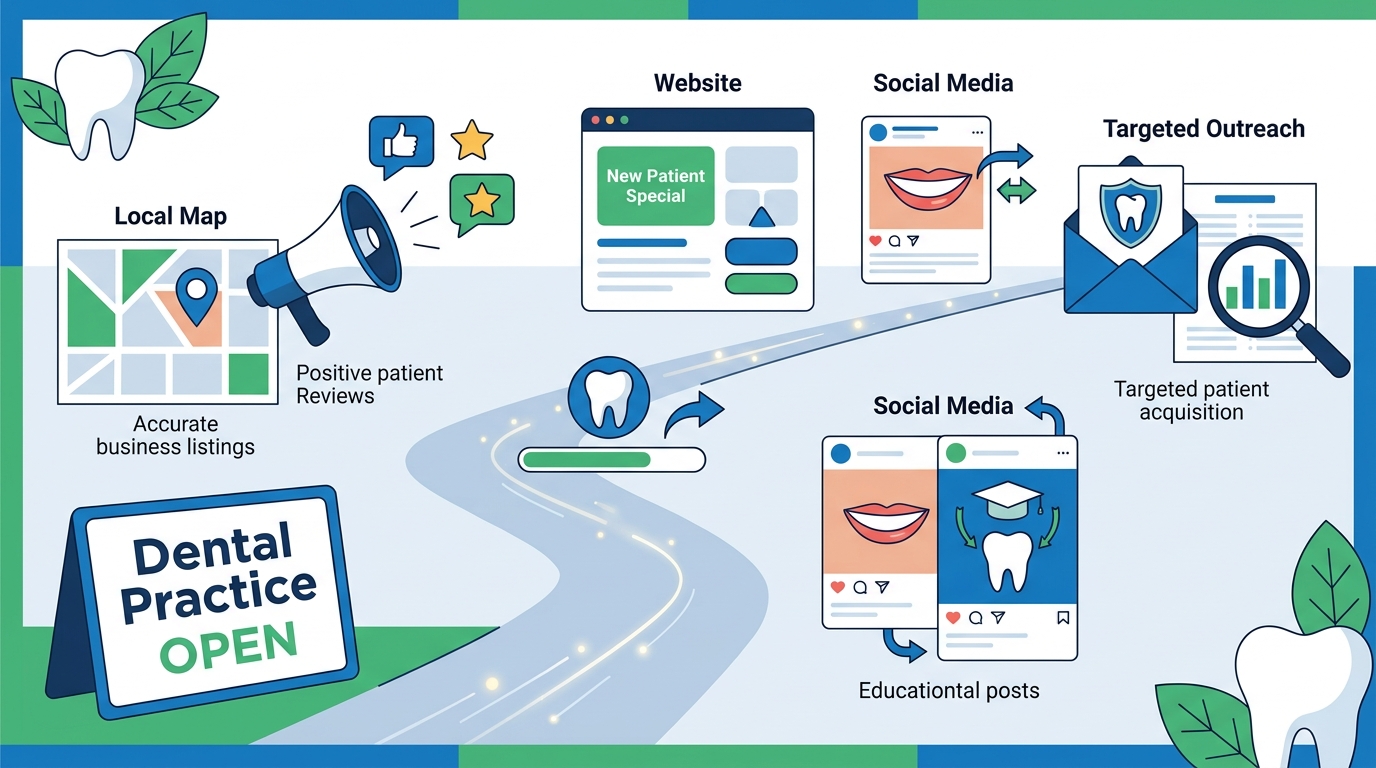
Your Google Business Profile (GBP) is the primary source of data for your pin on Google Maps. Make sure your practice name, address, phone number, hours, and services are accurate and consistent. Add high-quality photos of your office, team, and before-and-after results regularly. Learn eight ways dentists can improve their Google Map Pack rankings with actionable steps you can implement this week.
Local Citations and Backlinks
Consistent listings across directories like Yelp, Healthgrades, and your state dental association strengthen your Maps rankings. A strong dental marketing growth system typically includes national and local citations, branded profile setup across Google, Facebook, and Bing, plus geo-targeted landing pages for neighboring towns.
Build a Conversion-Optimized Dental Website
Your website is your digital front door. A conversion-optimized dental website is a site specifically designed to turn visitors into booked appointments through clear calls to action, mobile-friendly design, and fast load times. Tell Google and AI tools exactly what you do, where you are located, and which treatments you offer.
What High-Performing Dental Sites Include
Top dental websites feature 15 or more pages covering individual services, patient education videos, SSL security, and structured data that helps AI search engines cite your practice. Add real patient stories and before-and-after photos to boost your E-E-A-T (Experience, Expertise, Authority, and Trust) signals. Online booking increases conversion, especially after hours when your phones are off.
Pay-Per-Click Advertising for Quick Wins
Pay-per-click (PPC) advertising is a model where you pay only when someone clicks your ad, making it one of the fastest ways to generate new patient leads. Focus on high-intent keywords like "dentist near me," "emergency dentist [city]," and "dental implants [city]." Create dedicated landing pages for each campaign and monitor your cost per lead weekly.
| Marketing Channel | Time to Results | Avg. Cost per Patient | Best For |
|---|---|---|---|
| Google Ads (PPC) | 1-2 weeks | $150-$300 | Immediate new patient leads |
| Local SEO | 3-6 months | Low ongoing cost | Sustainable organic visibility |
| Social Media | 2-4 months | $100-$250 | Brand awareness and trust |
| Content Marketing | 6-12 months | Low ongoing cost | Long-term authority and SEO |
| Direct Mail (EDDM) | 2-4 weeks | $200-$400 | Local household reach |
The industry average cost per new patient acquisition is around $250, but practices using an optimized system can achieve a cost per acquisition as low as $150. A healthy marketing program should target a 3:1 to 5:1 return on investment.
Online Reviews and Reputation Management
Online reviews shape trust instantly. A majority of prospective patients check Google, Yelp, or Facebook before calling your office. Positive reviews also influence local search rankings, creating a compounding benefit.
Be proactive about requesting reviews from happy patients after every visit. Respond professionally to all reviews, including negative ones. Review acquisition systems can automate this process so your team does not have to remember every time. Strong review management is included in comprehensive practice growth solutions.
Content Marketing and Social Media
Content marketing builds long-term authority. Blog posts targeting questions your patients ask, such as "how much do dental implants cost" or "what to expect at a first dental visit," continue driving traffic for years. Post three to five times per week on Instagram and Facebook, mixing educational content, team highlights, and patient testimonials.
Short-form video through Reels and YouTube Shorts is especially effective in 2026. Video increases case acceptance and helps patients feel comfortable before they even walk through your door. Explore dental marketing ideas and strategies for more inspiration.
Tracking, ROI, and Choosing a Marketing Partner
Measure What Matters
Ask every new patient how they found you and track the answers consistently. Supplement this with call tracking using unique phone numbers per channel, Google Analytics for website traffic sources, and conversion tracking on your ad platforms. Over 50% of dental practices do not reliably monitor their marketing results, according to Dental Economics.
When to Hire a Dental Marketing Agency
If your marketing budget is under $3,000 per month, in-house management supplemented by AI tools may provide better value. Once your budget reaches $3,000 to $10,000 per month, a dental-specific marketing agency can deliver expertise that is difficult to replicate in-house. Look for agencies with dental-specific experience, transparent ROI reporting, no long-term contracts, and accessible leadership.
Flow New Patient Marketing, for example, operates on a no-contract, ROI-based model with a 94% client retention rate and has helped practices generate over $100 million in new patient revenue since 2010.
Key Takeaways
- Start with local SEO and Google Business Profile optimization. They are free and deliver high ROI.
- Your website must be conversion-optimized, mobile-friendly, and structured for AI search engines.
- PPC advertising delivers leads within weeks while SEO builds over months.
- Online reviews directly influence both patient trust and local search rankings.
- Track every marketing channel with call tracking, analytics, and patient source surveys.
- Aim for a 3:1 to 5:1 marketing ROI. The industry average cost per new patient is $250.
- Choose a dental-specific marketing partner that offers transparent reporting and no long-term contracts.
Frequently Asked Questions
What is dental marketing?
Dental marketing refers to strategies dentists and dental practices use to attract new patients and retain existing ones. It involves both digital methods like SEO, social media, and paid ads, as well as traditional methods such as direct mail and community events.
How much should a dental practice spend on marketing?
Most experts recommend allocating 3% to 5% of your annual revenue to marketing. If your budget is limited, start with Google Business Profile optimization, review generation, and a modest Google Ads budget of $500 to $1,000 per month.
How long does dental SEO take to show results?
SEO compounds over time. Expect six to twelve months before seeing significant organic traffic results. However, local SEO improvements like GBP optimization can show ranking changes within weeks.
What is the average cost per new dental patient?
The industry average is approximately $250 per new patient. Practices using optimized systems with targeted PPC and strong conversion processes can reduce this to around $150.
Should I hire a dental marketing agency or do it myself?
It depends on your budget and team capacity. Below $3,000 per month, in-house efforts with AI tools often work well. Above that, a specialized dental marketing agency provides expertise and execution that is hard to replicate alone. Learn more on the Flow New Patient Marketing FAQ page.
What marketing channels deliver the fastest results for dentists?
Google Ads (PPC) and Facebook/Instagram advertising deliver leads the fastest, often within one to two weeks. SEO and content marketing take longer but deliver compounding, sustainable growth.
How do I know if my dental marketing is working?
Track new patient phone calls, form submissions, cost per acquisition, and revenue generated from each channel. Use call tracking software and ask every new patient how they found you.
What is the most important dental marketing strategy for a new practice?
For a brand-new practice, a conversion-optimized website paired with Google Ads and Google Business Profile optimization provides the fastest path to filling your schedule. Marketing is an investment in your new practice, not an expense.
Ready to Fill Your Schedule with Quality Patients?
If you are a dentist ready to stop guessing and start growing, schedule a free strategy session with Flow New Patient Marketing. With 14+ years of dental marketing experience, a proven 5X average ROI, and zero long-term contracts, you get results without risk. Your first leads can arrive within 30 days.