

If you just opened a dental practice or finally decided to get serious about marketing, the options can feel overwhelming. SEO, Google Ads, social media, reviews, websites: where do you even start? The good news is you do not need dozens of tactics to see results. You need a handful of proven strategies executed well and consistently. This guide breaks down the best dental marketing strategies for beginners, with real data and actionable steps so you can start attracting high-value new patients this month. Whether you are a startup practice or an established office looking to grow, these fundamentals will set you up for long-term success.
1. Local SEO and Google Business Profile
Local SEO is the process of optimizing your online presence so your dental practice appears in location-based search results. In 2026, it is the single most important starting point for any dentist new to marketing. When patients search "dentist near me," Google Maps results appear first, and that is where most clicks happen.
Optimize Your Google Business Profile
Your Google Business Profile is the primary source of data for your listing in Google Maps. Select the correct business category, add your hours, upload real photos of your office, and write a compelling description that highlights your services. Encourage patients to leave reviews, as positive reviews directly improve your local ranking.
Local Citations and Directories
Ensure your practice name, address, and phone number (NAP) are consistent across all directories, including Healthgrades, Yelp, and your state dental association listing. Inconsistencies confuse search engines and hurt your visibility.
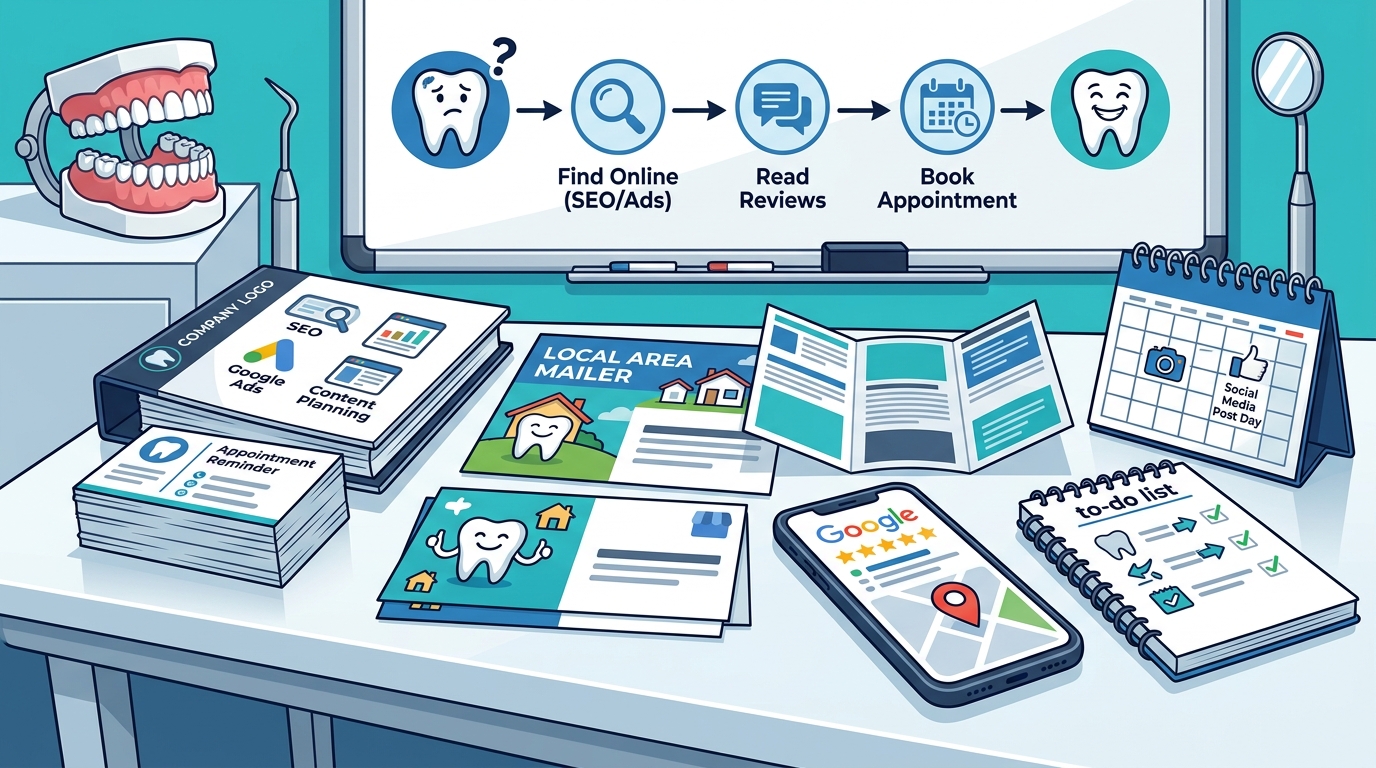
2. Build a Conversion-Optimized Website
A conversion-optimized website is a site designed specifically to turn visitors into patient appointments. It is not enough to simply have an online presence; your site must load fast, look professional on mobile devices, and make it effortless to contact your office.
Key elements include prominent phone numbers, online scheduling buttons, SSL security, and patient education content. Agencies like Flow New Patient Marketing build dental websites with 15+ pages, mobile-friendly design, and onsite SEO baked in from day one.
3. Pay-Per-Click Advertising
Pay-per-click (PPC) advertising is a model where you pay only when someone clicks your ad. Google Ads and Facebook Ads let you place your practice in front of people actively searching for dental care or matching your ideal patient profile. Focus on high-intent keywords like "emergency dentist" or "dental implants" in your local area.
What to Expect on Budget
Industry data suggests the average cost per new dental patient acquisition is around $250. However, well-optimized campaigns can cut that significantly. Flow New Patient Marketing reports an average CPA of $150 across all client solutions, roughly 40% below the industry average.
| Marketing Channel | Avg. Cost Per New Patient | Speed to Results | Best For |
|---|---|---|---|
| Local SEO | Low (time investment) | 3-6 months | Sustainable long-term visibility |
| Google Ads (PPC) | $150-$300 | Immediate | High-intent patient acquisition |
| Facebook/Instagram Ads | $100-$250 | 1-2 weeks | Cosmetic, implant, and awareness campaigns |
| Content Marketing | Low (time investment) | 3-12 months | Trust building and SEO authority |
| Review Management | Free-Low | Ongoing | Reputation and local rankings |
4. Online Reviews and Reputation Management
Online reviews are the digital version of word-of-mouth referrals, and they are more influential than ever. Nearly 90% of consumers read businesses' responses to reviews, according to DesignRush's 2026 dental marketing report. A strong review profile on Google, Facebook, and Yelp builds immediate trust with prospective patients.
Ask every satisfied patient to leave a review. Respond professionally to all feedback, positive or negative. Many dental practices working with Flow highlight reviews and call tracking as key drivers of their growth.
5. Content Marketing and Video
Content marketing is the practice of creating valuable, relevant information to attract and retain a clearly defined audience. For dentists, that means blog posts answering common patient questions, FAQ pages about procedures, and educational videos.
Video Is Non-Negotiable
Short, authentic video content builds trust faster than any other format. You do not need a film crew. Pull out your phone, answer one patient question, and post it. Patients trust raw, handheld video because it feels genuine. Explore more dental marketing ideas on the Flow blog for content inspiration.
6. Social Media for Dental Practices
Social media marketing for dentists is not about going viral. It is about showing up consistently and letting potential patients see the human side of your practice. Educational clips, behind-the-scenes moments, team celebrations, and patient testimonials (with consent) all perform well.
Focus on one or two platforms, typically Facebook and Instagram, and post two to three times per week. Storytelling content is 22 times more likely to be remembered than facts alone, making it one of the most powerful tools in your 2026 marketing toolkit.
7. Lead Tracking and ROI Measurement
If you cannot measure it, you cannot improve it. Every beginner should set up call tracking, form tracking, and ask every new patient how they found your practice. Tools like Flow's PatientFlow Intelligence system provide real-time lead tracking, call recordings, and monthly call handling analysis so you know exactly what is working.
A dental marketing budget must show measurable results. Allocate 3 to 5 percent of your revenue to marketing, prioritize your website, local SEO, and reviews first, then layer in paid advertising as you grow.
Key Takeaways
- Start with local SEO and your Google Business Profile; it is the foundation of dental marketing visibility in 2026.
- Your website must be mobile-friendly, fast, and designed to convert visitors into appointments.
- PPC advertising delivers immediate patient leads; well-run campaigns average $150 per new patient versus the $250 industry average.
- Online reviews directly influence both patient decisions and local search rankings.
- Short, authentic video content builds trust faster than polished ads.
- Track every lead and measure ROI so you can double down on what works.
- You do not need 50 strategies. A few proven tactics executed consistently will outperform scattered efforts every time.
Frequently Asked Questions
How much should a new dental practice spend on marketing?
Most experts recommend allocating 3 to 5 percent of your practice revenue to marketing. For startups, that number may be higher in the first year to build initial patient volume. Prioritize your website, local SEO, and online ads before branching into additional channels.
What is the fastest way to get new dental patients?
Pay-per-click advertising on Google delivers the fastest results because your ads appear immediately when someone searches for a dentist. Combined with a strong website and call handling, many practices see leads within the first month.
Is SEO or PPC better for dentists?
They serve different purposes. SEO builds long-term organic visibility over 3 to 12 months. PPC delivers immediate traffic. The best approach combines both for short-term patient flow and long-term sustainability.
How important are Google reviews for a dental practice?
Extremely important. Reviews influence both patient trust and local search rankings. Practices with higher review counts and ratings consistently rank higher in Google Maps results and convert more website visitors into booked appointments.
Do I need social media as a dentist?
Social media is not mandatory, but it is highly beneficial. It humanizes your practice, builds familiarity with prospective patients, and supports your other marketing channels. Even two to three posts per week on Facebook or Instagram can make a meaningful difference.
Should I hire a dental marketing agency or do it myself?
If you are seeing patients full-time, you likely will not have the bandwidth to manage marketing effectively. An experienced dental marketing agency brings industry-specific expertise, saves you time, and typically delivers a stronger return on investment. Flow New Patient Marketing, for example, has 14+ years of dental marketing experience and a 94% client retention rate.
What is a good ROI for dental marketing?
A 3X to 5X return on your marketing investment is considered strong. That means for every $1 you spend, you generate $3 to $5 in production. Some practices achieve even higher returns with optimized campaigns and excellent call handling.
How do I track where my new patients are coming from?
Use call tracking software, form submission tracking, and train your front desk to ask every new patient how they found you. Platforms like Flow's PatientFlow Intelligence provide real-time dashboards showing calls, forms, and conversion metrics in one place.
Ready to Fill Your Schedule With High-Value Patients?
Getting started with dental marketing does not have to be complicated. The strategies in this guide will give you a strong foundation, but if you want expert help tailored to your practice, schedule a free strategy session with Flow New Patient Marketing. No contracts, no pressure, just a clear plan to grow your practice.