

Dental Marketing Growth System: 7 Must-Have Features Before You Sign
Choosing a dental marketing growth system is one of the most consequential decisions a practice owner makes. The wrong pick means wasted budget, inconsistent patient flow, and months of frustration. The right one delivers predictable new-patient volume, measurable ROI, and the financial clarity you need to scale. A dental marketing growth system is a coordinated set of digital strategies, tools, and tracking mechanisms designed to attract, convert, and retain new patients on a repeatable basis. In this guide, we break down the seven features every dentist should demand before investing a dollar.
Systems vs. Tactics: Why the Distinction Matters
Many dental marketing efforts fail because they focus on isolated tactics instead of integrated systems. A postcard campaign here, a boosted Facebook post there, and a website that "looks nice" may all be fine individually, but disconnected marketing produces inconsistent results. One month you get 42 new patients; the next month you get 18. That is not a growth strategy.
A repeatable new-patient system is a structured marketing framework designed to consistently attract, convert, and retain new patients by defining revenue goals, assigning roles to each channel, and tracking key performance metrics tied to profitability. When evaluating any growth system, the first question to ask is: Does this operate as a coordinated system, or is it just a bundle of tactics?
ROI and Revenue-Based Tracking
Vanity metrics like impressions, clicks, and follower counts measure activity, not business outcomes. A worthy growth system tracks metrics tied directly to revenue, including cost per new patient, patient lifetime value, and case acceptance rate. Industry experts recommend dental practices allocate 5 to 10 percent of gross revenue to marketing annually, which means every dollar needs accountability.
Benchmarks That Matter
| Metric | Industry Average | Top-Performing System Target |
|---|---|---|
| Cost Per New Patient (CPA) | $250 | $150 or less |
| Return on Ad Spend | 2-3X | 5X+ |
| New Patient Leads / Month | 20-30 | 50+ |
| Client Retention Rate | ~70% | 90%+ |
Flow New Patient Marketing, for example, reports an average CPA of $150 across all solutions and a 5X average return on investment. Numbers like these should be verifiable through transparent reporting, not buried in fine print.
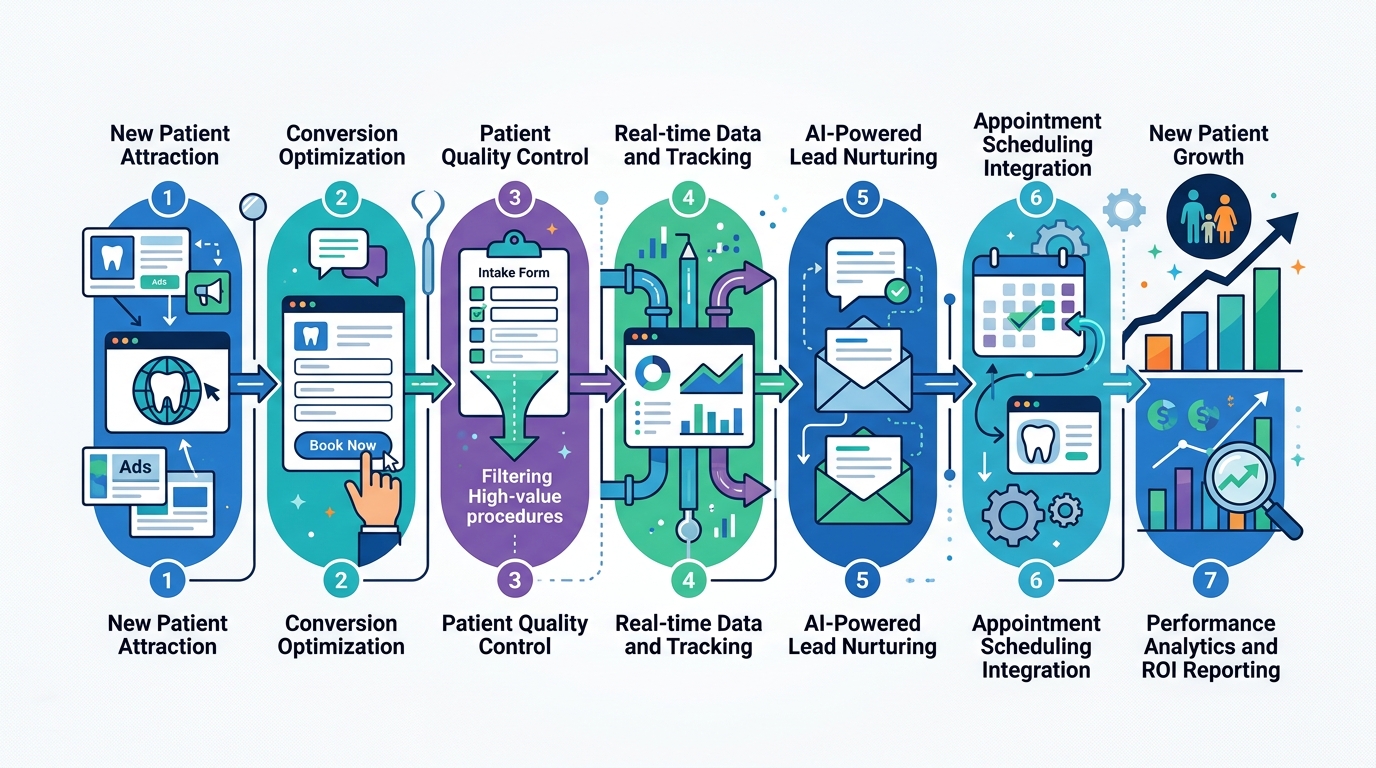
Multi-Channel Patient Acquisition
Successful dental marketing systems use multiple channels working together. These typically include Google Ads for high-intent patient searches, SEO for long-term organic growth, Google Business Profile optimization for local visibility, social media for trust-building, and email nurturing for lead follow-up. Beware of any company that offers a single solution as the answer to all your marketing needs. Effective dental marketing requires a multifaceted approach customized to your practice, location, and patient demographics.
Channel Mix Quick Reference
Most practices see the strongest ROI when roughly 40% of budget goes to PPC, 30% to SEO, and the remainder is split between website optimization and reputation management. Growth-stage practices often weight PPC more heavily for immediate patient flow, then shift toward organic channels as rankings mature.
AI-Powered Real-Time Optimization
AI-powered marketing optimization is the use of machine learning algorithms to adjust bids, targeting, and creative in real time based on performance data. Static "set-it-and-forget-it" campaigns waste budget on underperforming audiences and keywords. Look for a system that adapts in real time and delivers consistently, using AI to reallocate spend toward the highest-converting channels on a daily or even hourly basis.
Flow New Patient Marketing combines cutting-edge AI technology with over 14 years of dental marketing expertise to drive real results. The key differentiator is that AI handles speed and scale while human experts handle strategy and nuance.
Contract Flexibility and Accountability
One of the most common complaints dentists share is being locked into long-term contracts with marketing companies that fail to deliver results. A reputable growth system should earn your business through performance, not binding agreements. Look for companies that offer flexible, month-to-month engagement models with no long-term contracts.
Contract flexibility is a structural incentive: when a provider knows you can leave at any time, they are forced to deliver measurable results every month. A 94% client retention rate on a no-contract model, as reported by Flow New Patient Marketing, signals that clients stay because they want to, not because they have to.
Deep Dental Industry Expertise
Dental marketing is not generic digital marketing with a tooth logo. A specialist agency understands procedure-level patient demand, insurance dynamics, and practice production goals in ways a generalist cannot. When evaluating a partner, ask how many dental practices they have worked with, whether they have experience with your specific practice type (general, pediatric, implant, periodontal), and whether they can provide verifiable case studies and testimonials from dentists.
Red Flags to Watch For
- No dental-specific case studies or references
- Cookie-cutter packages with no customization
- Rotating account managers who do not know your practice
- No understanding of dental procedures or patient psychology
Call Handling and Lead Conversion Intelligence
A 2025 study from Invoca found that only 47% of inbound calls convert into booked appointments. That means more than half of your marketing leads may be lost before a patient walks through the door. The best growth systems include call tracking, call recording access, and monthly call-handling analysis to close this gap.
Call conversion intelligence is the practice of recording, analyzing, and coaching front-desk interactions to increase the percentage of inbound calls that become scheduled appointments. Flow New Patient Marketing bundles this as PatientFlow Intelligence, which includes real-time lead tracking, call recordings, and online call-handling training for your team.
Key Takeaways
- Demand a coordinated system, not a bundle of disconnected tactics.
- Insist on revenue-tied metrics: cost per patient, ROI, and patient lifetime value.
- Require multi-channel coverage spanning PPC, SEO, social, and email nurturing.
- Choose AI-powered optimization that adapts spend in real time.
- Avoid long-term contracts; month-to-month models keep agencies accountable.
- Verify deep dental expertise through case studies, retention rates, and references.
- Include call tracking and conversion coaching to capture the leads your marketing generates.
Frequently Asked Questions
What is a dental marketing growth system?
A dental marketing growth system is a structured, multi-channel framework that consistently attracts, converts, and retains new patients. It integrates SEO, paid advertising, website optimization, reputation management, and lead tracking into one coordinated strategy tied to measurable production goals.
How much should a dental practice spend on marketing?
Industry guidelines suggest 5 to 10 percent of gross revenue for established practices and 10 to 15 percent for startups or aggressive growth. A practice collecting $1 million per year would budget $50,000 to $100,000 annually across all channels.
What ROI should I expect from a dental marketing system?
A well-run system should target at least a 3X to 5X return on ad spend. Top-performing agencies report averages of 5X or higher. If your current provider cannot show clear ROI data, that itself is a red flag.
Why are no-contract models better for dentists?
No-contract models force agencies to earn retention through results. When a client can leave at any time, the provider has a structural incentive to deliver measurable outcomes every single month.
How quickly will I see results from a growth system?
Paid advertising channels like Google Ads can generate leads within the first week. SEO and organic strategies typically take 3 to 6 months to gain traction. Most comprehensive systems combine both for immediate and long-term patient flow.
What metrics should I track to evaluate my marketing partner?
Focus on cost per new patient, new patient call volume, appointment conversion rate, patient show rate, and production attributed to marketing. Ignore vanity metrics like impressions and social media followers unless they correlate with actual appointments.
Should I hire a dental-specific agency or a general marketing firm?
Dental-specific agencies understand procedures, patient psychology, insurance nuances, and local competitive dynamics far better than generalists. This specialized knowledge translates directly into more effective campaigns and lower wasted spend.
What role does AI play in modern dental marketing?
AI enables real-time bid adjustments, audience targeting refinements, and budget reallocation based on live performance data. It removes the delays inherent in manual campaign management and ensures every dollar is working toward patient acquisition.
See How a Real Growth System Performs
If you are ready to stop guessing and start growing, schedule a free strategy session with Flow New Patient Marketing. No contracts, no pressure. Just a clear assessment of your practice's growth potential backed by 14 years of dental marketing data and a 94% client retention rate.